Industrial Maintenance Skills Shortage: How Immersive Tools Help Pass on Expertise
Retirements, hiring difficulties, staff turnover: industrial maintenance is short of people, but above all short of know-how. When an experienced technician leaves a site, they take with them years of knowledge about installations they are often the only one to know so well. In this article, you will see why traditional knowledge transfer methods are no longer enough, and how digital twins and immersive tools make it possible to capture this know-how and train new hires faster.
Industrial maintenance: a lasting skills shortage
Hiring in industrial maintenance has become a real headache. According to the Labour Needs Survey by France Travail, the French public employment service, nearly 78% of planned hires for industrial maintenance technicians and supervisors are considered difficult by employers.
Three trends are adding up:
-
Retirements: a generation of technicians who have known the installations since they were commissioned is leaving the sites.
-
A lack of trained candidates: technical training programmes struggle to attract students, and experienced profiles are in high demand.
-
Turnover: new hires change employers more often, which means training never stops.
So the problem is not just finding technicians. It is getting them up to speed quickly on specific installations that are often complex and sometimes hazardous.
Tacit know-how: what is really at risk
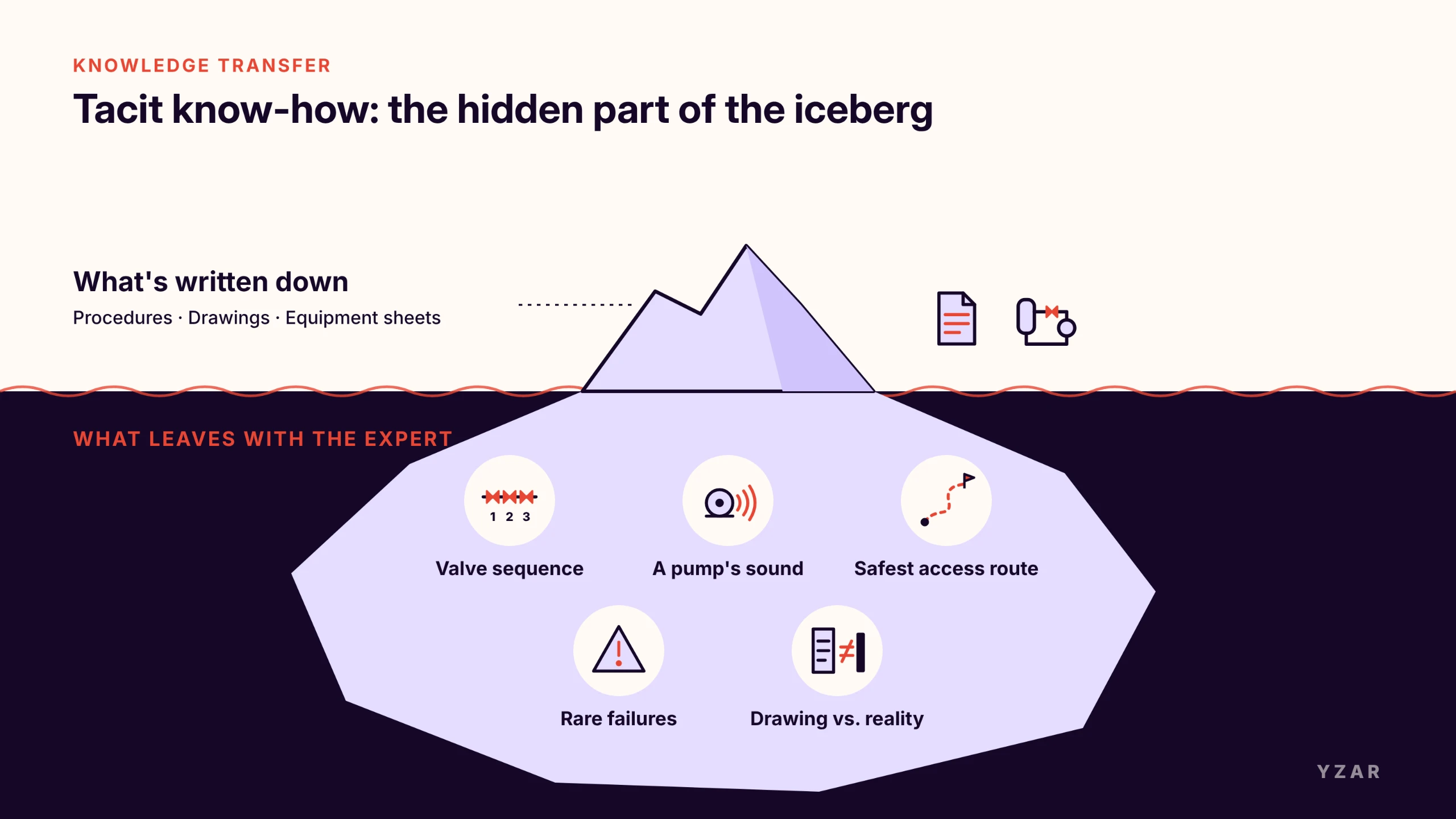
Much of the know-how in maintenance is not written down anywhere. This is what we call tacit know-how: knowledge gained through experience, which experts apply without even thinking about it.
In the field, it looks like this:
-
the exact order in which to open the valves to restart a unit smoothly;
-
the noise or vibration that signals a pump is about to fail;
-
the safest way to reach a badly placed piece of equipment;
-
the rare breakdown that happened ten years ago, and how it was fixed;
-
the small differences between what the drawings show and what was actually installed.
This knowledge is specific to each site and each installation. No generic training can replace it: it is learned in the field. When an expert leaves without passing it on, the company loses it, and then pays for it in longer breakdowns, errors and safety risks.
Why traditional knowledge transfer methods fall short
On-the-job mentoring remains the best way to learn a maintenance trade. But on its own, it can no longer keep up with the scale of the need and the limited availability of experts.
-
It takes time. Becoming autonomous on a complex installation can take months of mentoring.
-
It ties up experts. Every hour spent training is an hour not spent on maintenance work, while these same experts are already stretched thin.
-
It depends on chance. New hires learn from whatever breakdowns happen during their training period. Rare or complex cases may never come up.
-
It exposes trainees to risk. On a hazardous installation, learning in the field means facing real situations before being fully ready.
Other training formats have their limits too. Procedure binders are rarely up to date and hard to connect to the field. Classroom training stays generic and does not show the actual installation.
Digital twins, virtual reality, augmented reality: what immersive tools change
Immersive tools do not replace field experience. They help people get there better prepared, faster and with fewer risks. Three types of tools are often mentioned:
-
Virtual reality (VR) immerses the learner in a simulated environment through a headset. It is effective for practising gestures, but the environment is often generic, and the headset makes teamwork harder.
-
Augmented reality (AR) overlays information on the real world, for example on a tablet pointed at a piece of equipment. It provides guidance in the field, but you have to be there already.
-
A digital twin is an accurate, navigable and interactive replica of the real site. You move around it as if you were there, click on a piece of equipment to see its documentation, and follow a circuit on the process diagram.
To transfer know-how tied to a specific installation, the digital twin has a decisive advantage: it reproduces the exact site the technician will work on. You do not learn about “a pump”, you learn about pump P-204 in unit 3, in its real surroundings. The twin can be viewed on a PC, a tablet or a VR headset: these technologies complement each other more than they compete.
How to capture and transfer know-how with a digital twin
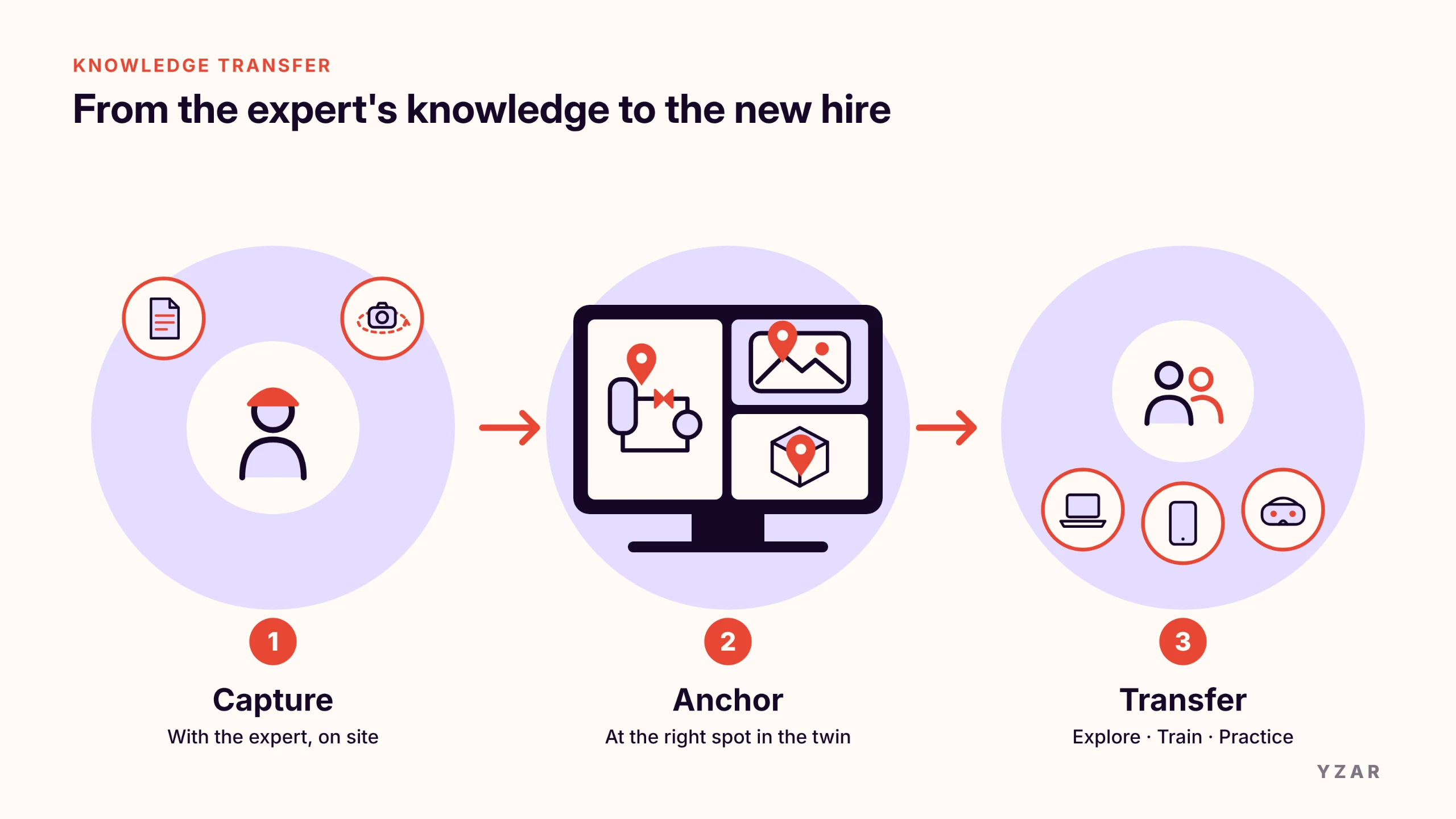
The digital twin becomes the installation’s memory and a training tool. Know-how is no longer stored in a binder, but attached to the exact spot where it applies.
1. Capture expert knowledge where it applies
Together with the expert, you walk through the installation in the twin and document everything in the right place:
-
step-by-step procedures with comments, on the equipment concerned;
-
points of caution: hot zones, hard-to-reach valves, risk of confusing two pieces of equipment;
-
lessons learned from past breakdowns: symptoms, causes, solution;
-
gaps between the drawings and what is actually on site.
2. Make this knowledge available to new hires
New hires explore the installation virtually, at their own pace. They can review a procedure as many times as needed, without disturbing a colleague or waiting for a job to come up. When they arrive on site, they already know their way around, and they can call on the expert for a specific case rather than for the whole training.
3. Practice on real scenarios
This is where the digital twin makes the difference. You can build scenarios around the situations a technician needs to handle, including those that cannot be reproduced for real:
-
a rare breakdown, replayed from a real incident on the site;
-
a lockout/tagout procedure on critical equipment;
-
an emergency, such as a leak or an alarm, with the right reflexes to adopt.
The technician makes mistakes in the virtual world, with no consequences and, above all, in complete safety, rather than on the real installation.
Training without tying up experts or stopping production
The digital twin frees training from two constraints that hold it back on most sites.
-
Expert availability: once their knowledge is captured, it remains accessible without them being there. Experts step in to validate and add to it, no longer to repeat themselves.
-
Installation availability: training no longer ties up a production line. This is crucial on sites where every shutdown is costly.
The results are measurable. Among YZAR’s clients, operators are 75% more efficient in the field, and return on investment is achieved in under 6 months, according to our clients’ estimates.
FILI: a digital twin designed for maintenance knowledge transfer
FILI is designed mainly for process industries with heavy operational constraints: chemicals, pyrotechnics, food processing, pharmaceuticals, building materials. On these sites, losing know-how is costly, and learning in the field carries risks.
FILI is built on three synchronised views of the installation:
-
the process diagram (P&ID), to understand circuits and flows;
-
the immersive 360° view, built from photos of the site, to find your way around as if you were there;
-
3D modelling, to visualise equipment and scenarios.
FILI’s real strength lies in how it is used. Teams train on scenarios specific to their own site and installation, built with their own experts. The captured know-how stays within the company, available to every new hire, even after the people who held it have left.
5 best practices for a successful knowledge transfer project
-
Involve experts from the start. They are the ones who hold the know-how. Their involvement ensures accurate content and helps win the teams’ buy-in.
-
Start with critical situations. Focus first on sensitive equipment, high-risk procedures and experts close to retirement, rather than trying to cover everything at once.
-
Plan ahead for departures. Capture an expert’s know-how in the months before they leave, not after.
-
Build the tool into existing training paths. The digital twin should be part of every new hire’s onboarding, not a stand-alone tool that nobody opens.
-
Keep the twin up to date. When the installation changes, the twin and its procedures must follow, or teams will stop trusting it.
FAQ: knowledge transfer in industrial maintenance
How can you pass on know-how before an expert retires?
By capturing it while the expert is still there. The most effective way is to walk through the installation with them and document their gestures, points of caution and lessons learned directly on the equipment concerned, for example in a digital twin.
Does a digital twin replace on-the-job mentoring?
No, it complements it. New hires discover the installation and practise in the twin, then go deeper in the field with a mentor. Mentoring becomes shorter and more useful, because it focuses on what can only be learned for real.
What is the difference between virtual reality and a digital twin for training?
Virtual reality is a way of viewing an environment, often through a headset. The digital twin is the content: an accurate replica of your site. A digital twin can be viewed in virtual reality, but also on a PC or tablet.
How long does it take to train a technician with a digital twin?
It depends on the installation and the role. Among YZAR’s clients, operators trained with FILI are 75% more efficient in the field, and training time is cut by 50% (client estimates).
Don’t let your know-how walk out the door
The skills shortage in industrial maintenance will not resolve itself. The companies that cope best will be those that capture their experts’ knowledge now and make it available to every new hire. Adopting a digital twin is also a great way to attract young talent.
Want to see how a digital twin can preserve your teams’ know-how? Discover FILI and request a demo.
Read also: What is a digital twin? Definition, how it works and examples