What role AR play in meeting environmental challenges?

To meet today's environmental challenges, it is more than ever necessary to implement measures and raise awareness of ecological issues. Immersive technologies now seem to be essential tools for tackling these issues and raising awareness of the impact of our daily actions on the environment.*
Augmented Reality to raise awareness of environmental issues
Faced with today's environmental and climate challenges, people's consciences are gradually waking up, yet there are still many who have not made any changes in their daily lives in favour of ecology. By offering a better representation of the human impact on the planet, both now and in the future, Augmented Reality could be a solution to encourage people to take real action.
Scientific studies have shown that Augmented Reality has a real influence on human behaviour, as it enables information to be viewed in an immersive way. When applied to the environment, this technology allows users to see first-hand the impact of human activity on the planet. By visualising the consequences of their actions, people can be made more aware of the importance of their behaviour in preserving the environment. They can be encouraged to make changes in their daily lives, such as reducing their use of plastic, taking environmental impact into account in their purchasing decisions, or adopting more sustainable modes of transport.
Numerous AR applications designed to raise public awareness of various issues already exist today, and they now seem essential for drawing attention to the ecological cause. The WWF Ice Simulator application, for example, simulates melting ice and rising sea levels in users' personal environments, providing a striking illustration of the impact of climate change on the polar regions. The WWF organisation has also developed technology to visualise the impact of plastic pollution on the oceans and marine life. Their application allows you to see marine animals evolving in a virtual sea filled with plastic. From immersive awareness-raising applications to serious games designed to educate people to do the right thing, there are many AR awareness-raising systems covering a wide range of issues. Augmented Reality experiences can be used to visualise the deforestation of the Amazon rainforest and the disappearance of certain animal species as a result of climate change, as well as the amount of waste we produce and the pollution particles in our city air in real time.
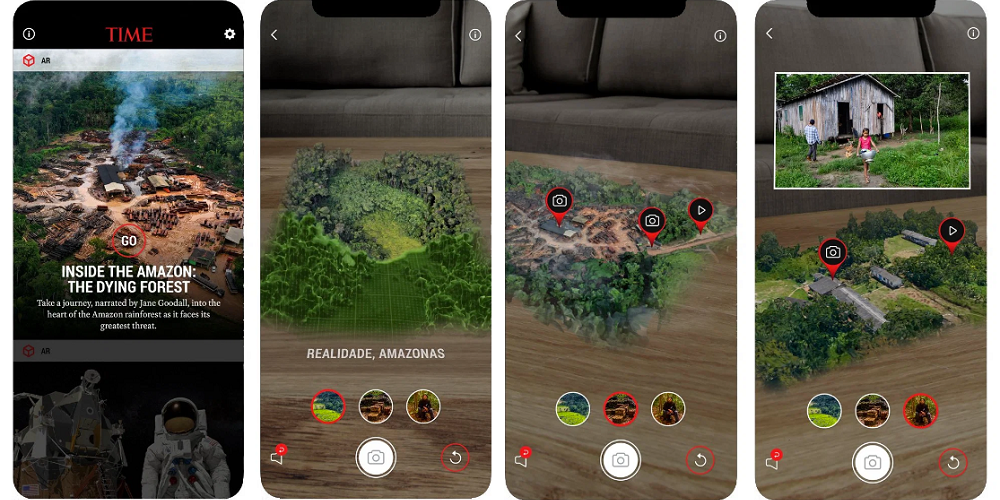
Augmented Reality application showing the deforestation of the Amazon rainforest.
Some devices even allow you to measure your own carbon footprint and suggest alternatives for reducing it. The immersive aspect of this technology makes it possible to raise awareness more effectively. It not only captures users' attention more effectively, but also enhances their memory, by making the consequences of their actions more tangible.
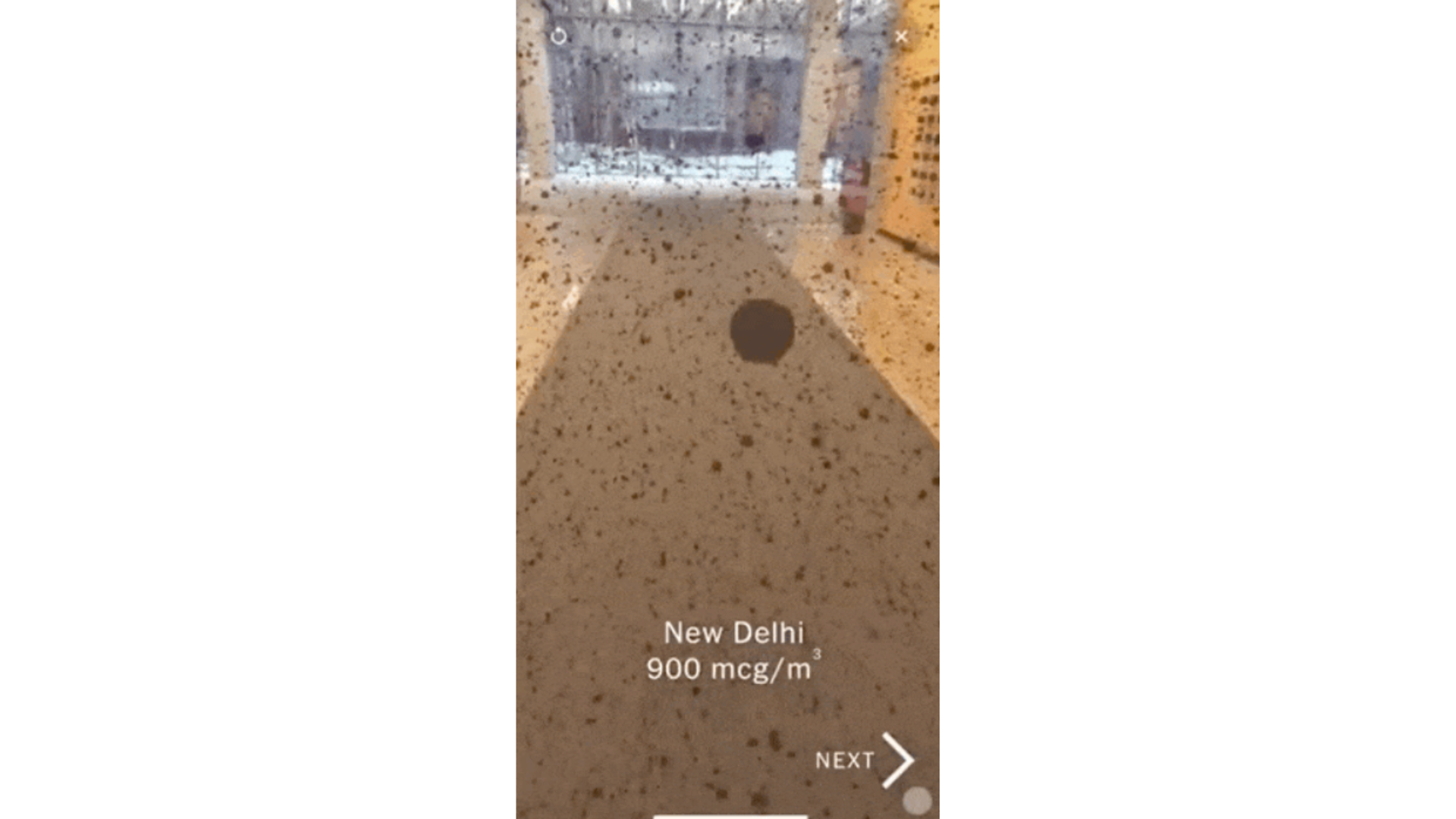
An application that lets you see the pollution particles in the air where you are.
Augmented Reality to reduce our carbon footprint
As well as raising awareness, Augmented Reality can also be used to reduce our carbon footprint. In fact, this technology makes virtual trips and visits possible, thereby reducing the need for physical travel. It can also be used in a professional context, for remote meetings and events, which also reduces greenhouse gas emissions linked to transport.
Augmented reality has also led to virtual fittings, enabling customers to make more informed purchasing decisions and reducing unnecessary returns. IKEA, for example, uses an Augmented Reality device to enable customers to see the furniture in their homes before they buy it. As well as reducing emissions linked to logistics management, this also helps to reduce unnecessary production.

Augmented Reality application showing the deforestation of the Amazon rainforest.
Finally, Augmented Reality can also be used to optimise production processes, particularly in the construction and industrial sectors, helping to reduce energy consumption and greenhouse gas emissions. In fact, this tool can help to reduce design errors by adjusting all the construction parameters beforehand, in a virtual environment. The technology can also be used to train employees in complex tasks, particularly in industry. Taken together, these uses reduce transport and material wastage, as well as cutting costs and emissions.
In short, Augmented Reality can contribute to the fight against climate change, while offering a better understanding of environmental issues and the progress of pollution. It is also a way of limiting certain emissions, by reducing our travel or our consumption of materials and energy. So it seems that this technology is an essential tool for tackling the various environmental challenges we face today.