Transforming the athletic experience with AR

Augmented Reality technology has grown exponentially in recent years, and continues to revolutionise many sectors, including the world of sport. AR is a technology that superimposes virtual elements onto the vision of the real world, offering an interactive, informative and immersive experience. In sport, AR has the potential to radically transform the experience of athletes, spectators and coaches. This article explores the many ways in which AR is being used in sport.
Training and refereeing with Augmented Reality
One of the most obvious applications of AR in sport is its use in athlete training. Top athletes can benefit from immersive training sessions where real-time data, such as speed, trajectory and performance, is projected directly into their field of vision. Augmented Reality goggles can provide crucial information without athletes having to look away from their serve, a cyclist can track his pedalling cadence, and a golfer can assess the distance to the hole.

Use of Augmented Reality for referees.
AR can also be used to improve refereeing and decision-making in sports. AR-enabled cameras can provide precise viewing angles and high-precision measurements to help referees make more accurate decisions. For example, in football, goal detection systems use AR to determine whether a ball has crossed the goal line. Similarly, the technology can be used to detect fouls and infringements, helping to reduce refereeing errors.
Augmented Reality for spectators and the disabled
Sports fans are not left out. Thanks to augmented reality, instead of watching the match on TV, your kitchen table or living room coffee table will be transformed into a virtual pitch, where you can see the players running, dribbling and scoring in miniature. AR enhances the viewing experience by allowing spectators to access real-time statistics, contextual commentary and graphical analysis while watching a match. Sports teams and event organisers are using AR to enhance the fan experience. Augmented Reality applications allow spectators to take part in interactive games, discover information about players and teams, and personalise their experience by choosing different views and camera angles. In addition, AR allows fans to connect and share moments with other sports enthusiasts through social media features.
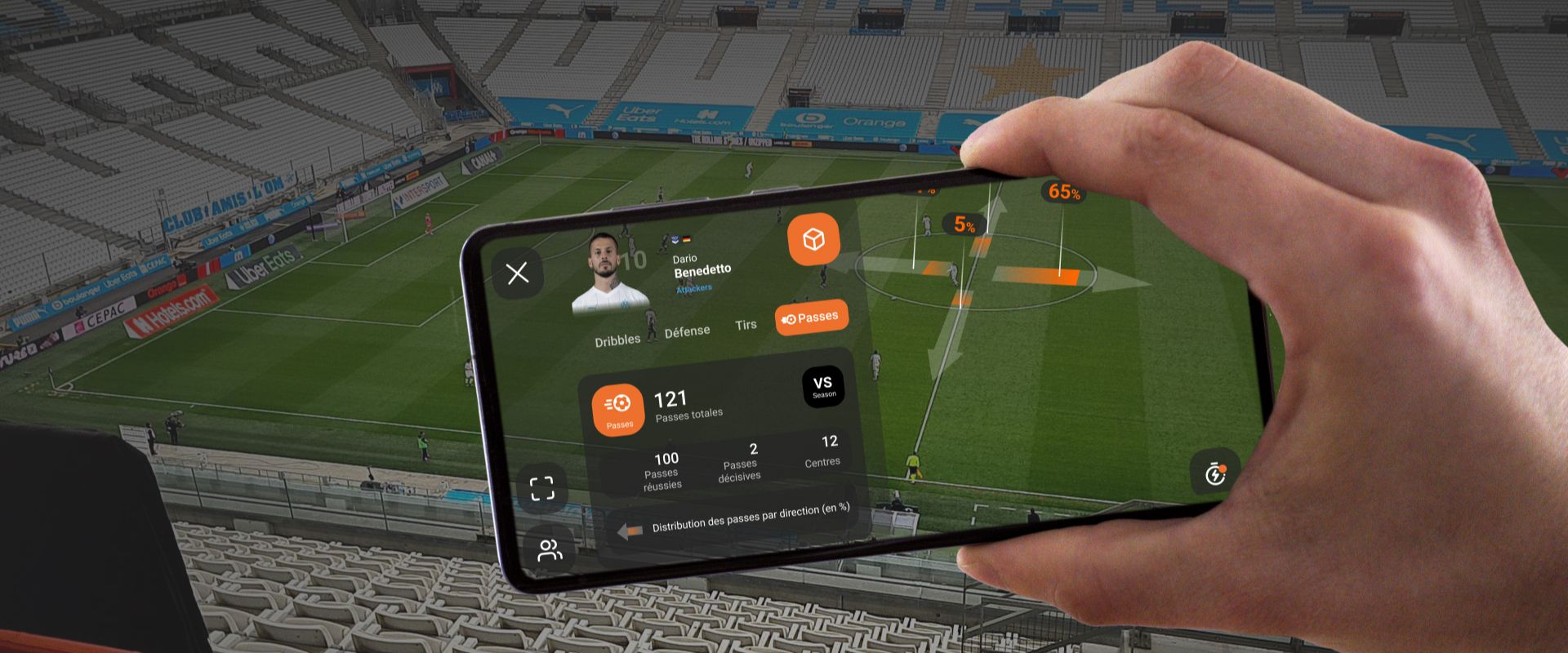
Photo credit : Orange & immersiv.io.
Augmented Reality will enhance the sporting experience of disabled people, removing physical barriers and creating opportunities for inclusion. Taking tennis as an example, AR can be used for wheelchair tennis to adjust the dimensions of the court or the rules of the game to enable equitable participation. In addition, thanks to AR applications, disabled people will have access to audio descriptions, tactile information or subtitles in AR to enable blind, deaf or hard-of-hearing people to follow and understand the game. Disabled people will also have access to AR applications providing them with real-time information on the location of accessible facilities, accessible routes and ancillary services, thereby enhancing their independence.
Augmented Reality is revolutionising the world of sport by providing a more immersive and informative experience for athletes, spectators and event organisers. The increasing use of AR glasses, mobile apps and smart sensors promises to transform the way we play, watch and experience sport. As the technology continues to develop, we can expect AR to continue to expand its applications and enhance the sporting experience for all.