Industrial operations: How AR and VR reduce errors and risks

In today’s industrial landscape, every on-site operation presents a challenge. The complexity of equipment, safety requirements, and tight deadlines make mistakes costly and potentially dangerous. To address these challenges, immersive technologies—3D, augmented reality (AR), and virtual reality (VR)—are emerging as strategic tools for preparing, guiding, and ensuring the safety of operations.
Prepare for operations ahead of time with immersive simulation
Before responding to an incident on-site, it is now possible to replicate the industrial environment in 3D or VR. This simulation allows operators to familiarize themselves with the facility, visualize the equipment in its real-world context, and anticipate potential risks. By training in a virtual environment, they can practice critical procedures without putting anyone in danger.
An OECD study (2024) highlights that VR is particularly useful for scenarios that are dangerous or costly to replicate in the real world. The results show that operators trained in VR have a better understanding of procedures and arrive on-site more confident and effective (oecd.org). This approach not only reduces preparation time but also improves the precision of actions during the actual intervention.
Reducing Errors and Guiding Field Operations
In the field, Augmented Reality transforms how operations are carried out. AR glasses or onboard displays show instructions and critical data in real time. Operators know exactly which step to take, and potential errors are detected and corrected immediately. AR thus reduces reliance on paper manuals and constant expert supervision, while increasing productivity.
A recent study confirms that the benefits are very real (distrilist.eu):
- up to 40% time savings on complex tasks with AR assistance
- significant reduction in errors thanks to visual and interactive guides
Enhanced Safety for Operators
Safety remains a top priority. With VR, operators can practice performing delicate procedures or resolving critical situations without any real risk. AR, on the other hand, allows contextual alerts to be overlaid directly onto equipment, providing real-time information on pressure, temperature, or other critical parameters.
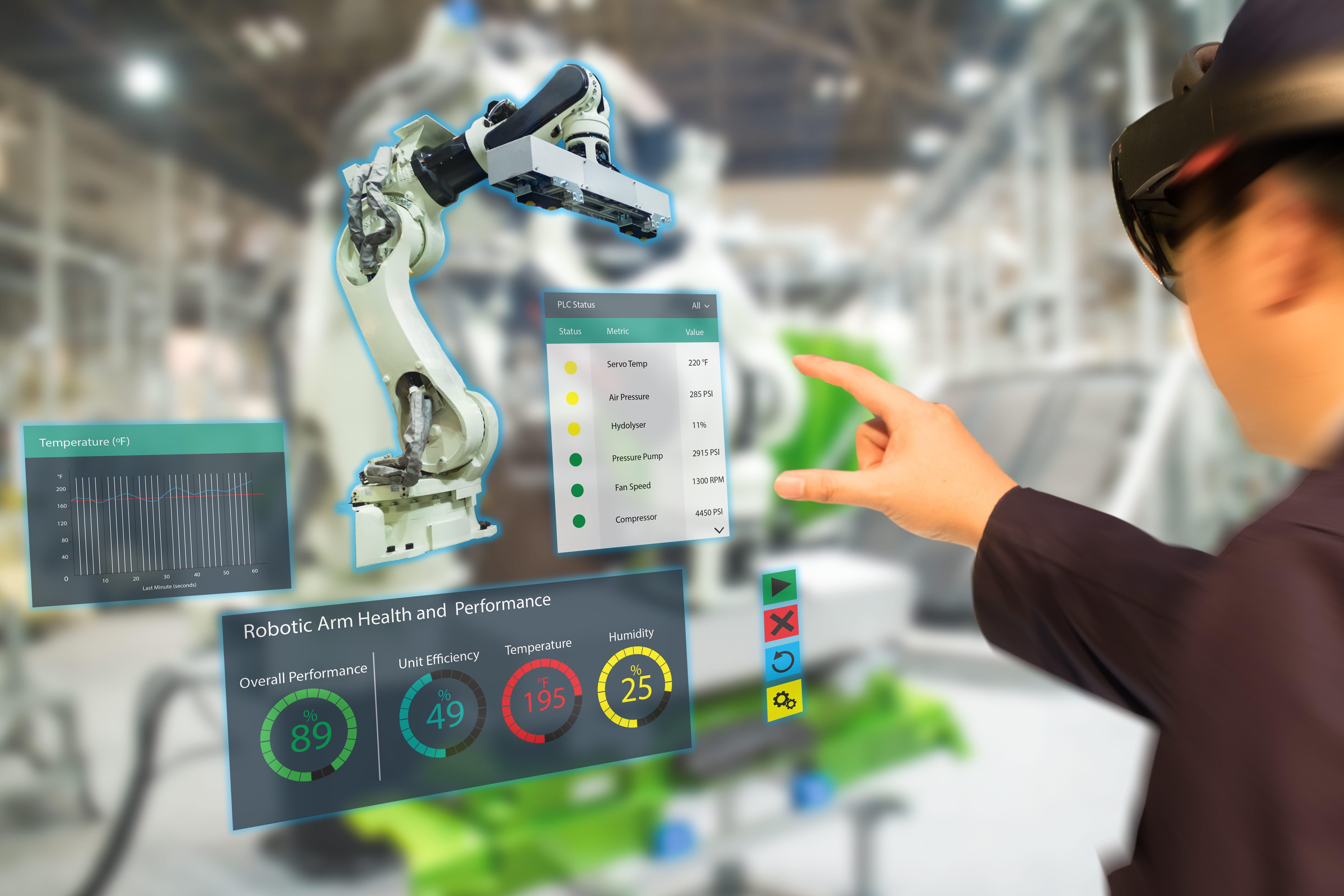
Research shows that VR can increase risk awareness by 30% and improve safety behaviors (nature.com). Furthermore, becoming accustomed to complex scenarios in a virtual environment helps reduce stress in real-life situations and ensures safer, more controlled responses.
Optimizing Response Time and Performance
Beyond safety, operational efficiency is directly impacted. Immersive training accelerates learning and skill development. Operators trained in VR grasp procedures more quickly and retain the knowledge they’ve acquired more effectively.
Some key figures (industrialtechmag.com):
- training up to 4 times faster in VR
- significantly higher knowledge retention rates
- improved precision of movements and execution Some industrial companies have already observed:
- 25% reduction in training time
- Faster and more reliable operations By combining AR and VR, it becomes possible to plan, execute, and monitor operations with a level of precision and safety that is difficult to achieve using traditional methods. The impact on productivity and reliability is immediate, and operators are better prepared to handle critical situations.
Training for emergencies and critical incidents without actual risk
Beyond preparing for technical procedures, virtual reality makes it possible to simulate incident scenarios that are difficult, if not impossible, to replicate in real-world conditions. Fires, equipment failures, leaks, and human errors can be recreated with a high degree of realism, while posing no risk to operators.
A meta-analysis of over 50 studies confirms that VR training outperforms traditional methods in terms of knowledge acquisition and retention, particularly in high-risk situations. In practical terms, this means that operators no longer simply know the procedures: they have already experienced, tested, and internalized them in contexts that closely resemble reality (https://www.sciencedirect.com/science/article/pii/S0925753523003144? ).
Toward a Human-Centered Augmented Industry
These technologies are not intended to replace humans, but to enhance their capabilities. By providing advanced training and assistance tools, they enable teams to better understand complex systems and collaborate effectively, even remotely. They are part of a broader vision of Industry 5.0, where the safety, performance, and well-being of operators are at the heart of the transformation (mdpi.com).
Conclusion
Prepare. Guide. Ensure safety. Speed up. 3D, AR, and VR technologies are no longer just “nice-to-have” tools. They are becoming operational standards for manufacturers seeking to:
- reduce human error
- improve safety
- optimize performance Manufacturers who adopt these technologies quickly see these three key benefits. The question is no longer whether these tools are useful, but how much risk and wasted time we can still afford without them.
Sources :
- OECD – Digital Economy Outlook 2024 (OECD)
- Scientific Reports (2025) – VR & sécurité au travail (Nature)
- MDPI (2025) – Impact de la réalité augmentée dans l’industrie (MDPI)
- Platform Executive (2025) – AR/VR maintenance & training (Platform Executive)
- Industrial Tech Magazine – VR training performance (industrialtechmag.com)
- DistriList (2025) – Gains opérationnels AR/VR (Distrilist.eu)
- Applied Ergonomics (2025) – VR/AR et ergonomie (ScienceDirect)
- ICED25 (2025) – Industry 5.0 & immersive tech (Skillaibility)
- Recherches académiques VR/AR (2024–2025) (arXiv)
- Science Direct (2024) https://www.sciencedirect.com/science/article/pii/S0925753523003144?