What is Augmented Reality ?

With the rise of digital technology, many innovations are appearing every day. One of them represents the future: Augmented Reality (AR). It can be defined as the superimposition of virtual elements to the real environment, it is already present in our daily lives. Augmented Reality represents a tool of the future in any field and for professionals as well as for individuals.
Introduction to AR
At the beginning, Augmented Reality was mainly used in the aviation and military sectors, mainly for MRO (Maintenance, Repair and Overhaul). Indeed, the military personnel could visualize in advance the actions to be performed. It will then be used in the medical sector for many reasons but particularly as an aid for medical students in order, for example, to be able to visualize the veins of the patient before taking a blood sample, with the Viewer application.

Visualization of a patient's veins.
It is in the 2000's that Augmented Reality will make its appearance to the general public. In 2010, it has been fully adopted. It was the sales sector that was the first to take hold of Augmented Reality. For this sector, it was an opportunity to attract attention and make a real difference with original and interactive posters (as Sephora had done). But it was definitely the world of social networks that really launched Augmented Reality in society. Indeed, it was the first time that the innovation could be used by anyone with a smartphone.
Mixed Reality (XR) is a mix between Augmented Reality and Virtual Reality (VR). Augmented Reality allows an interaction between individuals, virtual reality and the environment. The different technologies that make it up extend over the spectrum of Mixed Reality developed by Milgram and Kishino. Thus, Augmented Reality aims to create an environment of cohabitation between the real and the virtual. AR must integrate the totality of the real elements and the virtual elements must adapt and be coherent with each image. For this, many technologies such as geolocation or 3D modeling are used. To create an Augmented Reality experience, two techniques exist. The first, called Marker-based, works by placing markers on a previously recorded image. These markers can be elements or an image itself and must present a sufficient contrast with the rest to be detected later. These markers will then be used as cues to activate the virtual elements. The second, more recent technique is called Markerless and as its name suggests, it does not require markers to be placed on the image. Particular characteristics such as colors, objects, patterns, are entered into an algorithm and the activation of virtual elements will be done each time the device used detects these characteristics.
The evolution of Augmented Reality
It was in 1990 that Augmented Reality really developed. Virtual Reality is less recent. However, if the idea of a reality that could be virtually modified, is not recent. In 1901, in his novel "The Master Key", L. Frank Baum told us the story of a pair of glasses that allowed the person who wore them to know the personality of the people they met. Indeed, these glasses made appear on their face a letter corresponding to their main character trait. Baum's imagination thus gives us a founding idea of Augmented Reality, a reality enhanced by an object bringing elements of information to the user. It is in the 1960s that the first Augmented Reality inventions will appear. It all began in 1962 when the American filmmaker Morton Heilig developed his Sensorama. His goal was to use the five human senses to optimize the viewing of a film. The machine included a screen, a stereo system, fans, a mobile chair and odor simulators, all of which were activated according to the feature film being viewed and the actions being visualized.
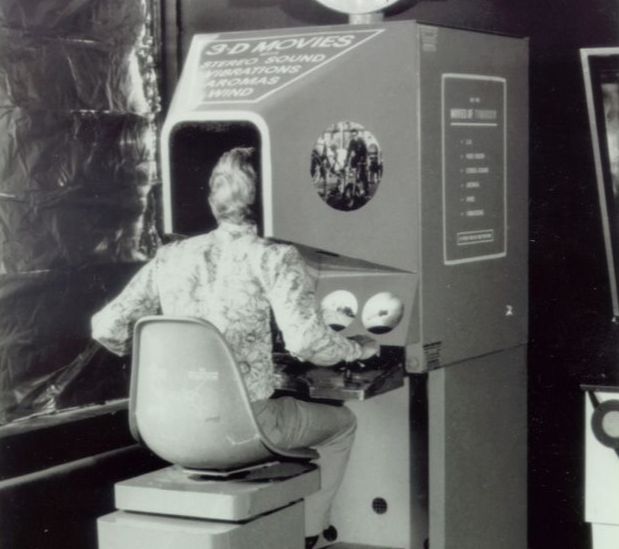
Morton Heilig's Sensorama
The evolution of Augmented Reality will take a turn in the 1980's, with the arrival of HUD or Head-Up Displays. These systems make it possible to display informative elements in the user's field of vision through a transparent screen without the user having to make any particular movement. This technology allowed pilots of airplanes to be informed of the altitude or speed without taking their eyes off their trajectory, the information being integrated into the Augmented Reality. In 2012, there is the arrival of Google Glass, science fiction will thus become almost reality. These are the first Augmented Reality glasses to be accessible to the general public. However, it would not be a commercial success and Google will decide to stop their production in 2015. Other pairs of glasses like the Hololens developed by Microsoft are now much more powerful but reserved for professional uses. Another highlight in 2014, Snapchat released its geofilters that allowed to add informative 2D elements to a photo or video. It was from this point on that other social networks like Facebook or Instagram for example got into it as well. The race to Augmented Reality was thus launched. Pure and hard competition: when some offer filters that can modify our face, others allow us to place ourselves in virtual worlds.
 Snapchat filters that allow us to place ourselves in virtual worlds.
Augmented Reality is the fact of superimposing virtual elements to the real environment. It is also helping us to understand, learn and facilitate many activities, today and in the future. It is not only a great tool for individuals, it is also a great tool for companies for whom it represents a way to make a difference.